Who is Bill Federer? William J. Federer is an American author, historian, and public speaker known for his work examining America’s founding documents, religious history, and the influence of faith on American society.
Federer is the author of America’s God and Country Encyclopedia of Quotations, a collection of historical quotations from American founders, presidents, and other notable figures.
He also appears as a featured contributor in Church and State: Roger Williams and the Founding of Freedom of Religion, offering his perspective on American religious history, freedom of conscience, and the historical relationship between church and state.

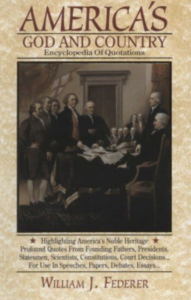 Best Selling Book: America’s God and Country-Encylopedia of Quotations
Bill Federer is a best-selling author, historian, and public speaker known for his extensive research into America’s founding documents, early leaders, and the influence of religious belief on Western civilization.
He is the author of numerous books, including America’s God and Country Encyclopedia of Quotations, which compiles thousands of primary-source quotations from America’s founders, presidents, and early leaders. Federer’s work emphasizes documented history over modern interpretation, a core principle shared by Church and State.
Bill Federer’s Role in Church and State
In Church and State: Roger Williams and the Founding of Freedom of Religion, Bill Federer provides historical insight that helps viewers understand what separation of church and state originally meant—and what it did not mean.
Federer explains that early Americans sought to:
-
Protect religious freedom from government control
-
Prevent state-run churches and coerced belief
-
Preserve freedom of conscience for all faiths
His commentary reinforces the documentary’s central argument:
Religious liberty was designed to protect faith from the state—not to remove faith from public life.
Roger Williams, Religious Liberty, and Historical Context
Much of Bill Federer’s research aligns with the story of Roger Williams, the 17th-century founder of Rhode Island and one of the earliest advocates for full religious liberty in America.
Federer highlights how Williams believed that:
-
Faith must be voluntary, not enforced by law
-
Government power corrupts religion when it attempts control
-
Civil peace depends on respecting conscience
These ideas became foundational to the American understanding of church-state separation, later influencing the First Amendment.
Church and State: Myths vs. Historical Reality
A major contribution Bill Federer makes—both in the documentary and in his broader work—is addressing common misconceptions about church and state, including the idea that America was founded as a secular or atheistic nation.
Using original documents, Federer demonstrates that:
-
The founders frequently referenced God, Providence, and moral law
-
Religious belief was seen as compatible with liberty
-
Moral virtue was considered essential to self-government
Church and State uses Federer’s research to contrast modern narratives with historical evidence.
Why Bill Federer’s Work Matters Today
As the United States approaches its 250th anniversary, Bill Federer’s historical scholarship is increasingly relevant. Questions about religious freedom, public morality, and government authority remain unresolved—and deeply rooted in America’s founding debates.
Federer’s work reminds audiences that:
-
Liberty requires moral restraint
-
Freedom of religion protects diversity, not uniformity
-
History must be understood through original sources, not modern interpretations
These themes are central to Church and State and to the ongoing conversation about America’s identity.
Watch Church and State: Roger Williams and the Founding of Freedom of Religion
Church and State features Bill Federer alongside historians, scholars, and original documents to explore the true origins of religious liberty in America.
🎬 Watch the documentary on YouTube below